|

The beginning
|
|
|
|
|

Bow view in beginning
|
|

Stern view in beginning
|
|
|
|
|

Loading onto my trailer
|
|

(Insert New Caption)
|
This was my wife's first look at the project. She just could not see the potential.
|
|
|
Deck was in fairly good shape but stringers were shot.
|

First indications of trouble
|
|

And more
|
Serious stringer issues.
|
|
|
To go any further I needed it out of the weather.
|

Slipping her into the garage
|
|

Fits like a glove
|
Her new home for over a year.
|
|
|
At this point I have the whole deck removed, all old transom wood removed and one of the stringers dug out. It took over 2 hours with a chisel and hammer to dig each stringer out of the "pocket" where it was originally glassed into the hull. I'm only taking one stringer out at a time, then glassing the new one in so I don't lose the shape of the bottom of the hull. Note the wide gunwales and 2" x 4" stiffeners below them. I am going tio elimnate the stiffeners above the deck and re-design the gunwales later on.
|

First stringer removed
|
|

New transom going in
|
Here I'm glassing in the new transom. I glassed three layers of 3/4" treated plywood together then installed in the hull with my homemade clamps. I let the treated plywood air dry in the garage for about 8 weeks before using it.
|
|
|
First new stringer is in, next one has been removed.
|

First stringer installed
|
|

Second stringer
|
Second stringer ready to go in. I used kiln dried pressure treated 2" x 8" x 20 ft boards for these. The kiln dried wood is supposed bond much better with the fiberglass.
|
|
|
Here all of the stringers are in, the are spliced along their length since they didn't offer kiln dried lumber that was wide enough. I use PL polyurethane adhesive and 3" galvanized screws to attach them. I've also re-built the stiffeners on the sides from below the deck line and added supports where the deck joins the sides of the hull.
|

Stingers complete
|
|

Ready for the deck
|
At this point all of my deck supports are in. I added cross pieces at all the points where two sheet of plywood come together. All of this wood is pressure treated so not covered in glass.
|
|
|
New deck sheets in place, ready for glass. I used 1/2" pressure treated plywood, again I let it dry for several weeks before glassing.
|

New deck in
|
|

New console
|
Here's the new console set in place but not fiberglassed. The original fuel tank ran the whole width under the console. I wanted to fit my batteries under there as well so I cut and sectioned the tank. It still has about 33 gallon capacity. The fuel fill connection has to be installed on the left side of the console now.
|
|
|
The round deck hatch to the right of the console is for access to a valve that goes to a fitting thru the bottom of the hull to provide water to the livewell. I've removed the existing gunwale on the right side of the photo.
|

Another view of console
|
|

Gunwale test fit
|
This is my test to see if I could come up with a different gunwale design than original. I cut the two pieces to shape on a table saw then cut cross cut to help it around the curves. First I screwed thru the hull from the outside into the inner piece then ran a long screw thru the inner piece into the outer to sandwich the hull beteen them. Once I saw that this would work I repeated the process with full length dried out treated wood.
|
|
|
|

Bottom view of gunwale test
|
|

Console and seat installed
|
Now the new gunwales have are on, the console is glassed in with gauge and control cut-out done and the seat/storage box has been built.
|
|
|
Here you can see the battery location and the conduits for wiring and controls
|

Another console view
|
|

Deck complete
|
The deck is all glassed in and the gunwales are ready for fiberglass. I used a router to get the basic rounded edges then finshed with a grinder.
|
|
|
|

Close-up of gunwale before glass
|
|

Glassing gunwales
|
I ended up covering the gunwales in 1 layer of mat, then woven roven, then three more layers of mat. They turned out very strong and gave a lot of support to the side of the hull.
|
|
|
Here I'm beginning the new livewell. After this I lined the whole interior with 2" of foam insulation and cover in glass.
|

New livewell
|
|

Finished livewell
|
Livewell is complete. The PVC spray header is connected to the valve below deck that allows water to enter from a fitting on the bottom of the hull. When this valve is open and the boat is moving there is a continuous flow of fresh water into the livewell. The 1 1/2" overflow runs onto the deck then out of the drain holes in the side of the hull in the next photo. The lid will have 2" of insulation on the bottom side as well.
|
|
|
These openings on either side of the hull allows water to self-bail from the front deck. The 2" step up to the rear deck helps keep you from standing in water all the time. The rear deck drains thru two 1 1/4" holes in the transom.
|

Forward deck drains
|
|

Back outside
|
All fiberglass is pretty much complete at this point and she's back outside.
|
|
|
|

Another view
|
|

Outside of hull
|
Next step is to gelcoat the interior. After that I'll start fixing all of the dings in the exterior and get it ready for paint.
|
|
|
A view of the inside of the livewell lid with insulation glassed in place.
|

Livewell lid
|
|

Interior gelcoat done
|
Finally got the interior gelcoat complete. Rolled on the gray with a roller and then sprayed the "squiggles" with black gelcoat with webbing additive. It came out of the gun just like spider webs and drifted onto the wet grey gelcoat. Hardest part was try to make it all look even.
|
|
|
|

More interior shots
|
|

Interior
|
|
|
|
|

Interior
|
|

Interior
|
Next step is paint the exterior.
|
|
|
Sanding, sanding and more sanding.
|

Fairing the hull
|
|

In primer
|
2 coats of Intelux epoxy primer on sides and bottom of hull. And more sanding.......
|
|
|
Rolled and tipped Interlux Perfection paint on sides of the hull (3 coats) and rolled on 2 coats of gelcoat on bottom of hull. Done sanding!!!
|

Hull painted
|
|

Motor's on
|
Spruced up my old '87 Merc 175 with new lower unit seals and water pump and painted everything. It actually started and ran after sitting up for 5 or 6 years.
|
|
|
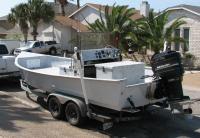
Found a used trailer for cheap that just barely fits.
|

Trailer
|
|

Trailer modificatons
|
I cut off all the old trailer bunks and supports and fabricated new supports for the 2" x 12" bunks. Still need to clean up and paint all the welds and carpet the bunks.
|
|
|
|

Trailer modifications
|
|

Mayden Voyage
|
A mere 25 months after I started this little project, the boat ran pretty well. I still have some motor issues, stator related I think (4500 rpm is all I could get). Other than that I'm really pleased with the outcome. I still need to get a windshield fabrcicated, install the SS fuel tank, rod holders, etc. Trim tabs are also on the list when the budget allows, they will really help the slow speed performance. On to the next project.........'65 Ford tractor restoration.
|
|
|
Here with all final details complete. Windshield installed, SS fuel tank, trim tabs, depth finder, etc. All motor issues have been resolved, she runs right at 50 MPH with a light load.
|
Done Done
|
|


