|

Exterior View
|
So, here's where we start. 1987 Bayliner Capri. Doesn't look too bad from this angle, huh ?
|
|
Shortly after we purchased the boat, we splurged on all new interior upholestry. The local guy we used did a beautiful job, so the thought of trashing all his good work was painful.
Now, the Force outboard, that's another story...
|

Rear - Port Side
|
|

Rear - Starboard Side
|
Another view of the rear seat area.
|
|
|
Looking forward. Like the way to 2 consoles sag ? They would flop around when running the boat; all the supporting structure was rotten. I attempted many times to secure things, using bigger and bigger screws, bolts, etc. But, no matter what I did, nothing would hold it together.
|

Looking forward
|
|

Sagging Port side console
|
Closer view of the port side console. Notice the black areas ? I later found out these were thin, molded plastic covers that would lift off in 1 piece, exposing the gelcoated fiberglass console underneath. On this side, the fiberglass underneath was in the same shape as the black plastic cover. No so on the starboard side..
|
|
|
On the starboard side, the molded black plastic dashboard is very much different in geometry from the fiberglass console underneath. My best guess is that they pre-assembled the wiring and instruments into the black plastic overlay, and then could just drop it in place, once the assembly process was ready for it.
|

Sagging Starboard side console
|
|

Rotten deck
|
Yeah, under all the cheap carpet, the floor is rotten. BAD !!
|
|
|
Yeah, its all rotten under here too.
|

Bow Seating Area
|
|

Under Bow Seat
|
Just poke this with your finger and it falls apart
|
|
|
There was no way for any collected water to drain away from this area. So, this was all rotted.
|

Under Startboard Rear Seat
|
|

Gas Tank Exposed
|
So, get out the sawzall and get to work. In this view, the rotted decking is coming out. I stopped to pump the remaining few gallons of gas out of the tank. Wow, what a crummy design. Aluminum tank sitting right on the bottom of the hull, surrounded by bilge water. No wonder it started leaking.
|
|
|
Rear deck is out. As I suspected, the stringers are shot too. I found out later that the wooden stringers were not even bonded to the hull !! To remove them, I cut the top of the 'glass off of them AND WAS ABLE TO LIFT OUT THE SOMEWHAT INTACT WOOD. Nothing was bonded together.
|

First look at the stringers
|
|

Cross Braces Gone
|
This is where one of the cross bracing frames USED TO be.
|
|
|
Yeah, they were rotted too. And the foam.... Completely waterlogged everywhere I found it. Literally, hundreds of pounds of saturated foam came out of this boat.
|

Seat bases removed
|
|

Back-to-back seat frames
|
For some reason, they chose to build the seat bases much stronger than anything around them or supporting them. Yeah, soaked foam under there too.
|
|
|
After removing seat bases. Look at the stringers...
|

Looking forward
|
|

Rotted mess under console
|
A mess... rot, soaked foam, etc. Cut it all out.
|
|
|
That's as far as I can go with the sawzall. Time for that grinder.
|

All the wood and foam is out
|
|

Look aft
|
After grinding it all down, here's whats left. Gotta wear a good mask when doing this stuff. Tremendous amount of dust gets generated.
|
|
|
All cleaned out.
|

Looking Forward
|
|

New cross bracing going in
|
Here, they're bonded in place. I found good solid Ipe mahogany 1x6 stock for the new stringers and braces.
|
|
|
The stringers, cross braces, and transom knees are in; 3 layers of epoxy and 9oz. fabric holding it together.
|

Stringers are in
|
|

First section of deck going in
|
I decided to work from front to back in the rebuild. There's lots of tricky woodworking to do so that it all fits and STAYS together.
|
|
|
Looking forward between the consoles, the structure is coming together. All the big parts are tabbed in and ready for epoxy and cloth. Take a look at the patch I needed to make for the dashboard. It was originally sawed right thru from the factory to make room for the wiring. No wonder it sagged...
|

Bow seating area
|
|

Bow seat base
|
This should be a bit stronger now.
|
|
|
The hull was joined to the deck with only pop rivets and caulking. There were a few places where leaks developed. This seemed like a good time to do this in a better way too. Here, a strip of plywood is first bonded accross the joint with 3M 5200, left to cure for week, then fully filleted and 'glassed in.
|

Hull/Deck Joint
|
|

Bow seating area ready for epoxy and cloth
|
No screws this time. Its all filleted and glassed in.
|
|
|
Same thing, looking forward this time
|

Looking forward
|
|

Bow eye reinforcing block
|
Yeah, that was all rotted too. I laminated a bunch of scraps of the Ipe into a block and glassed it in.
|
|
|
All one piece now. No more screws to pull out anymore.
|

New structure under port console
|
|

Both consoles - looking forward
|
It took quite a bit of temp bracing to pull all this back into shape. But, using the walk-thru windshield as a gauge was helpful. All plumb and square now.
|
|
|
Epoxy and cloth done.
|

Glassed In
|
|

View looking aft
|
Ready for final sanding and cleanup
|
|
|
Epoxy had formed a bit of "blush" when it cured. This was easily cleaned up with hot water and a kithen sponge. I put a coat of white paint on the upper area of the console. It'll need more but looks good so far.
|

Cleaned up and sanded
|
|

View looking forward
|
Ready for a coat of paint. I'll match up a blue, close to the color of the interior upholstery.
|
|
|
Not bad. It came out as good as I could have hoped. Its getting dusty already, but it still makes it seem like I'm getting somewhere.
|

Forward area painted
|
|

Using the old dash board as a mold for new one
|
The old black plastic dash board overlays were in bad shape, but I decided to use them as a mold to make new fibreglass ones. Here, the first one is molded.
|
|
|
Here's the finished part. It took some fighting to get it out of the plastic mold, mainly because of all the complex angles and shapes.
|

New drivers side dash panel
|
|

Here's where it goes
|
The new molded dash board will be fastened to the driver's side console.
|
|
|
Same idea with this one. I'll patch it up and use it as a mold also.
|

Passenger side dash overlay
|
|

Completed consoles
|
Finally they're done. The 2 parts I molded are now bonded into place and faired into the surrounding structure. The painting was tedious; 5 coats of black, lots of wet sanding and polishing. I got a little crazy and added the mahogany inlays (with 7 coats of varnish, more polishing....) but the end product is worth it. It will kill me to cut holes for gauges, switches, steering,etc.
|
|
|
Side view of the passenger side console.
|

Passenger side
|
|

Drivers Side
|
Side view of the drivers side console
|
|
|
Continuing the reinforcement of the deck/hull joint. Here's a question... why would they cut away so much of the side panel ? Yeah, its covered with an upholstered board, but cutting away so much of it really weakened it. Why....
|

Deck/Hull joint
|
|

Underside of side
|
Badly bonded plywood strips that were intended to provide backup for the upholstered panels. This also had to support the weight of the side windshields. The whole thing used to flop around when on the water. It all needs to come out, and be replaced with something stronger
|
|
|
Something stronger is needed here
|

Close-up of separating plywood strips
|
|

Fitting in side panel
|
Here I have dry fitted a plywood section to give some stiffness to the sides. Once its all glassed in,it should stop the side windshield glass from flopping around.
|
|
|
Here is a view of the plywood section on the drivers side
|

Same on the drivers side
|
|

Drivers side panel finished
|
Here the plywood panel on the drivers side is completed; Fully glassed in. There is an upholstered panel that attaches to this. This adds a lot more strength.
|
|
|
This shows the completed panel on the passenger side.
|

Passenger side panel finished
|
|

Bilge drainage improvement
|
Before glassing in the next section of plywood decking, I glassed in a section of 3" PVC pipe cut in half to allow the flow of any bilge water from the bow area directly back. The original design had a removable deck panel presumably for under-floor storage. It was always the collection point for any rain or splash water that made its way into the bilge; useless for storage. I intend to fill the section with flotation foam so the glassed in pipe will allow drainage and protect the foam.
|
|
|
For now I'm leaving the center section open; where the gas tank goes. It will give me better access to the transom.
|

Next section of deck glassed in
|
|

Foam Test
|
Also had a chance to try installing some of the pour-in foam. This is good stuff. It expands and fills the cavity under the deck real good.
|
|
|
I cut away a section of the splash well to get access to the transom. I was undecided at first about what to do with this. But since every piece of wood in this boat was rotten, why would the transom be any better ? It has to come out.
|

And now the transom
|
|

Stepped transom
|
These boats used a stepped transom, meaning that it doesn't extend all the way accross the stern. While glassing in the stringers I also glassed in these knee braces. I was not certain back then what else to do, but at this point I'll cut it all away and build something better.
|
|
|
Look closely... The transom is made from 1 piece of 3/4 plywood... Only 1 thickness... oh boy... I hope to put a new or late model outboard on the boat when I'm all done. The new 4 strokes weigh a good 100lbs more that the old Force clunker. Yeah, gonna need to beef this up... substantially.
|

What's this ??!!??
|
|

Old plywood cut away
|
View looking aft; the inner skin and the plywood has all been removed. Yeah, it was only 1 thickness of 3/4" plywood clearly not marine ply; there were a number of voids. That's all that supported the outboard....
|
|
|
Double thickness of 3/4" plywood. The reinforcing knees are a total of 3 thicknesses of 3/4" material; 2 of ply, 1 of the Ipe material used on the stringers
|

New Plywood Glassed In
|
|

Closer look at the reinforcing knees
|
This seems to be the key to all the strength in the transom. By tying it all together the loading from the outboard is backed up directly into the stringers.
|
|
|
The new transom, knees and stern wall with all the glass work finished and a coat of paint.
|
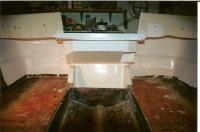
Transom and stern wall finished
|
|
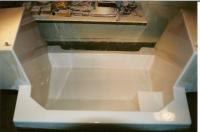
Motor Well reassembled
|
With the transom work finished the motor well section that I needed to cut away is now bonded back in place, faired in and painted.
|
|
|
On the left is a cardboard template of the shape of the hull; on the right is a template of the actual shape of the gas tank. Close in shape but work is needed to modify the compartment to suit the shape of the tank.
|
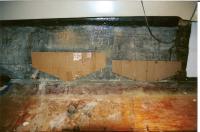
On to the gas tank
|
|
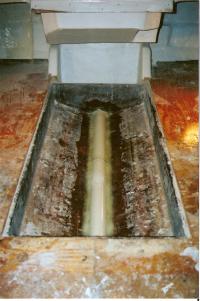
Bilge drainage
|
Similar to what I did earlier, First step was to glass in a 3" PVC pipe that is cut in half. This will allow the drainage of any bilge water from the front of the hull directly to the rear.
|
|
|
Next, 1x6 douglass fir boards were shaped to match the hull and PVC pipe angles and glassed in. This forms a solid flat surface for supporting the tank bottom.
|
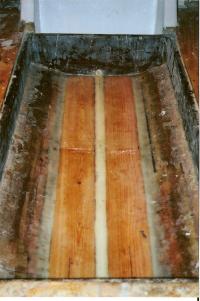
Flat surface
|
|
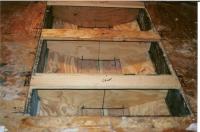
Assembly jig for angled sections
|
To hold the wooden angle pieces in the proper shape, I made these 3 jigs.
|
|
|
The shape is right. The tank (shown to the left in the picture) is ready to go in.
|
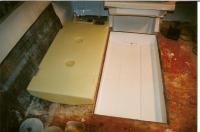
Finished - ready for tank to go in
|
|
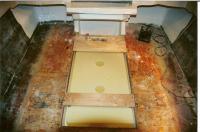
Tank going in
|
Here the tank is going in. The 2 cross pieces have wooden blocks on the underside matching the mounting pads on the tank to hold it in place.
|
|
|
Notice the epoxy edged cut out for the fittings. On the original, the plywood flooring was just cut away exposing raw edges. No wonder the floor rotted so badly.
|
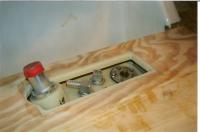
Closeup of tank fittings
|
|
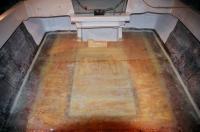
Tank fully installed
|
The last of the plywood deck is installed and fully glassed in.
|
|
|
The center section of the rear seating area is glassed in first.
|
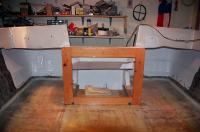
Construction of the rear seat bases
|
|
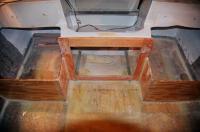
plywood seat boxes
|
The plywood seat boxes go in next connecting to the center section
|
|
|
Building upon the plywood boxes additional bracing is assembled. Also; the shelf-like attachments to the side of the hull and the supporting structure is in. The end result is that the seats will be solidly supported on 3 sides.
|
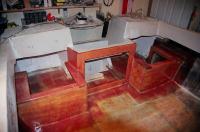
braces and reinforcements
|
|
Rear seating area completed
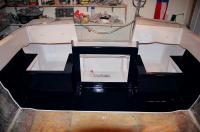
|
All cleaned up and painted.
|
|
|
The side storage bin panels are going in. This mimics the original size and shape of this useful storage area. Thinking ahead; note the markings on the deck for the seat boxes
|
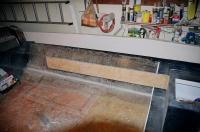
Side storage bin panels
|
|
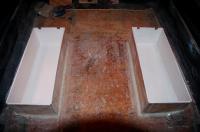
Seat boxes in
|
The bases for the back-to-back seats are in.
|
|
Everything's got a coat of paint finally.
Next; on to the electrical wiring and such. Not much to photograph while thats going on.
|
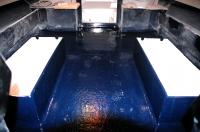
All the 'glass work is FINALLY done.
|
|
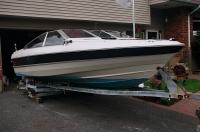
Finally out of the garage.
|
Lots of progress. All the wiring is done. The fuel line is in place. The upholstery panels are in. The windshield is back in place.
But mostly, notice that all the faded tape stripes are gone. I wet sanded the exterior and compounded it out to a decent shine.
|
|
Here's a shot of the finished transom.
Next - the motor.... wait 'till you see this !!!!!
|
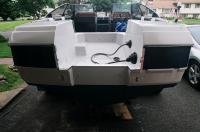
Transom
|
|
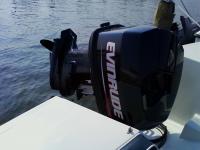
So where's the Force Outboard ?
|
It magically became an Evinrude. I just couldn't bear to put that old motor back on the boat after all that work.
|
|
|
I also couldn't justify spending over 10K for a new Yamaha either. So here we have a completely remanufactured "traditional" Evinrude 115.
|
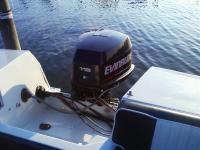
Re-man Evinrude 115
|
|
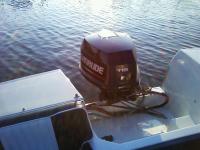
Like the old days
|
Simple, low-tech solution. Not many bells and whistles but it starts right up and runs. Not like the old Force....
|
|
So, that wraps it up. If anyone is considering a rebuild project like this, I wish you good luck and hope you find this to be helpful.
I'll see you on the bay.
|
That's all, folks
|
|


