|
|
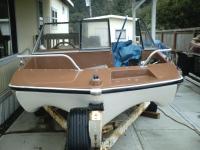
After cleaning out the dead cats, rats, birds, mildew etc.
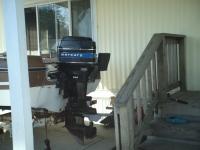
I rubbed out a small section at the back to see if finish could be restored, looked like new (not shown) Project is on hold until I get parts for engine (1978 Merc 800)
|
|
|
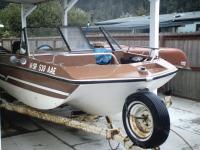
Trailer is a little rough, plan is to fix floor, stringers if needed, and floatation if needed from the inside, then off the trailer for bottom and trailer work.
|
|
|
|
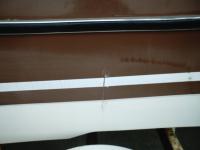
Crack port side
|
|
|
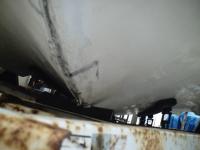
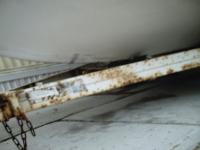
My guess is that this boat was run up on the beach one too many times. The previous owner suspected a leak in the keel so he smeared latex caulking all over. I filled boat with water to bottom of seats, leaks from the dark mark in this pic to the first roller, also leaks from crack in side.
|
|
|
|
A little farther back...
|
|
|
And farther...
|
|
|
|
And farther.
|
|
|
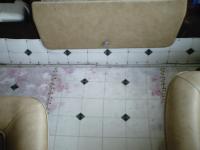
Floor covering installed by previous owner, soft spot starboard aft.
|
|
|
|
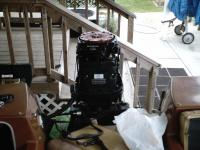
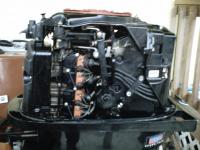
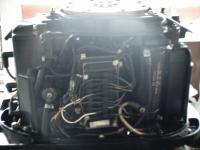
Merc looks like its brand new... Has 140 lbs compression all cylinders cold!!!, good spark, ran 2 gal.of 25:1 to lube things up.... smokes like a fiend. I decarbed it with Seafoam, tried adjusting the Idle mix, still idles rough as a cob and still smokes.
|
|
|
Carb rebuild is next, waiting for kits.
|
|
|
|
Still waiting...
|
|
|
(Insert New Description)
|
(Insert New Caption)
|
|
|
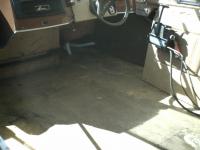
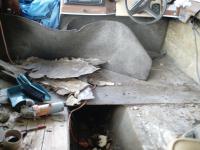
Seats out, carpet out...
|
|
|
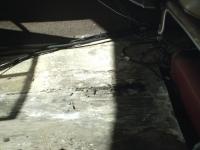
Port aft section of floor...
|
|
|
|
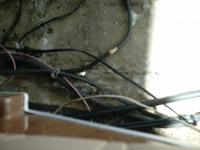
Starboard side floor aft... notice crack in firberglass and floor?
|
|
|
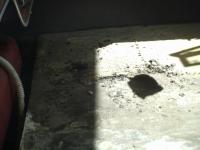
The whole deck across the back is rotten... port aft.
|
|
|
|
Floor was not glassed or epoxied, top or bottom except on edges.
|
|
|
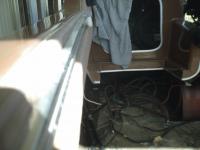
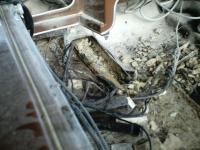
Now is that anyway to run elec. wires?... The whole wire and control cable system will be rebuilt
|
|
|
|
Bilge pump was just dropped in, wired up, and left to rattle around... never mounted
|
|
There is a 2x4 across the back tappered on the ends to match the hull... foamed in and glassed
A 1x10 stapled to that and run forward.
|
|
|
|
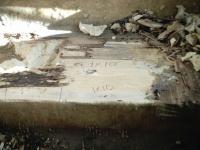
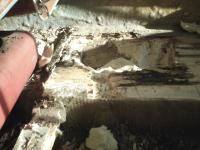
Floor is only rotted out where Previous owner stapled down vinyl floor, this penatrated to 1x10s... there are no stringers in this boat. If you look close you can see where I cut the top section of fiberglass where it joins the first 1x10 and the "V" well in the Keel.
|
|
|
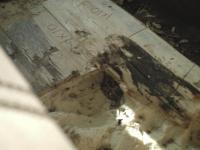
Again... there are no stringers in this design... The outsides of the floor are the first part of a Tri-angle.. glassed to the hull... this is the base for the hull design. This is a shallow V Tri-hull, so there really isn't room for stringers. The center is the strength, a deep triangle of 1/4 inch epoxy/glass bonded to the hull and the 1x10's... floor laid over that and epoxied should give you an inter-linked triangular support design... Flotation foam under that bonded to the top deck should be an engineering feat unparallel in boating history.. Right?... Nice design, pour execution... they didn't coat the bottom of the floor, didn't coat the top of the floor, ran screws, bolts, and staples thru top deck without any thought to future rot and water penetration, and were pretty damned sloppy with the keel well fiberglass work that is the key to the whole design... all that said, the floatation is dry? 1976?... run up on the beach enough to cause a small leak in keel?... I don't have to like the things they did, but it works, and gives me a chance to screw it up beyond redemption.
|
|
|
(Insert New Caption)
|
(Insert New Description)
|
|
|
(Insert New Description)
|
|
|
|
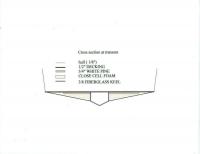
As you can see from the drawing, the keel box forms an open beam when laminated to the 3/4 pine, then to the floor, then to the hull... a series of triangles.
The keel box is formed from layers of woven roving and has a, IMHO, serious flaw, there is no shear support. The strands of the roving run with the joints and across the joints of the floor to hull bond so the only shear is from the resin.... not that strong.
I'm going to correct this defect by using 4 layers of 17 oz. bi-axial tape staggered up and across from the bottom of the keel box to the outside edge of the white pine. Glue the floor to the pine boards, radius the floor to the hull with a putty made of thixotropic powder, chopped strand, and epoxy. 4 layers of 17 oz. bi-axial tape, then an overlay of 12 oz. bi-axial cloth across floor and up the sides of hull to hull/top split.
|
|


