|
|
 |
|
| home |
| |
shopping |
| |
contact |
| |
projects |
| |
Warning: Undefined array key "session_logged_in" in /home2/sap/public_html/header.php on line 612
login | | | join |
|
|
|
|
Before I started. . . .
|
 |
|
|
|
|
|
|
|
|
|
|
|
May 4th 05 - Before Starting
|
|
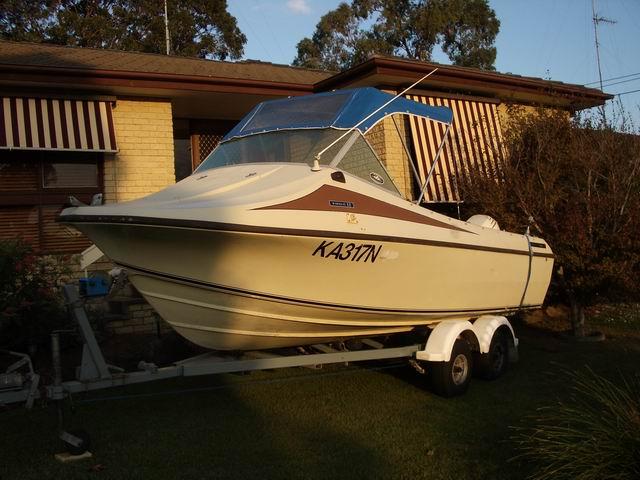
This winters project is to replace the transom on The Brown Hornet. For those that don’t know, TBH is a 1984 Seafarer Viking 17. It’s a classic fibreglass offshore fishing boat that handles the rough stuff incredibly well, is tough as nails and with stacks of fishing space which is perfect for my requirements. I’ve thought long and hard about buying a new hull but it’s money that could be better spent and as I intend having boats all my life, I’d like to have a crack at fibreglass repairs myself.
While there is no flex in the transom (even if I reef the leg of the raised outboard), I have drilled a couple of holes and the sawdust is damp. As I take the boat offshore where it cops a bit of a hiding, I want to have 110% confidence in the structural integrity of the hull so the transom is to be replaced and at the same time I’ll inspect and if required replace the floor and stringers as well.
I’ve done heaps of reading on this topic. By heaps I mean an estimated 50-100 hours over the last few months reviewing websites, reports, articles, books etc. The thing that amazes me is that there seems to be no obvious ‘best practice’ and opinions differ greatly between experts on the topic.
I’ll give you an example:
There are two basic approaches to replacing a transom. One is to cut the glass from the back (outside) skin of the transom to gain access to the timber innards. The second method is to cut and/or remove the deck & floor and cut the glass from the front (inside) of the transom to get to the timber. Some writers say that to go from the back is basically suicide and absolutely the wrong thing to do while other writers will say that cutting the exterior skin is by far the easiest and best way to go and to only go from the inside if the floor and/or stringers need work as well.
As you can see, the ‘best’ approach is not as clear as you might think. I want to do the best possible job but at the same time I don’t want to create unnecessary work for myself.
|
|
|
|
|
|
|
|
|
All projects on Shareaproject.com are user-submitted and should be used for reference information only. The projects are not intended to be complete "How-To" articles. Use the information contained in these projects at your own risk. Projects are not checked for completion, accuracy, or safety and therefore cannot be guaranteed in any way.
Outdoor Blog
|